
DEI (Diversity, Equity, and Inclusion) is a relatively recent concept in business. At the same time, it has quickly entered the mainstream as a force for good. You may have heard about the research showing that in medium and larger businesses, greater diversity in the workplace increases innovation and efficiency. To a certain extent, the biggest push for DEI has been in the traditionally homogeneous technology sector. But if you’re a small local business, an entrepreneur, or a freelancer, does any of this even apply to you?
You bet your sweet bottom-line it does. Let’s take a look, first by understanding what we’re talking about. (If you already know about DEI, you can skip down to the list of action items.)
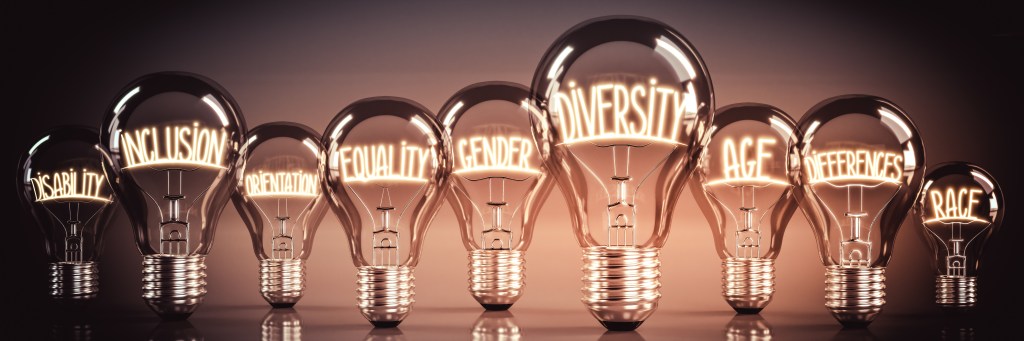
Diversity
Diversity is what you think it is–and more. It’s the differences that make “e pluribus unum” a foundational truth in the United States. James McKim is the founder of Organizational Ignition, which guides companies to improve performance. He’s in New Hampshire, whose population, he points out, is over 90% white. However, his article “The Business Case for Implementing DEI” offers a “diversity wheel” that shows how far beyond the basics of race, ethnicity, gender, or sexuality the idea goes. Things like marital status, military experience, physical ability, and area of work are just the tip of the iceberg. This means that even in an area that seems like there’s no diversity, you just have to look a little deeper to find all kinds.
Equity
Seeing and acknowledging diversity is just the first step, however. We are tempted to say that we’re all different, but we’ll treat each other equally, and call it good. But it’s crucial to understand what our differences mean in our lives and take that into account in the workplace. McKim gives a simple example based on body size: “Have you ever been given the same sized chair in your office as everyone else yet you are smaller (or larger) than most? Was not the chair uncomfortable, leading you to spend time addressing that discomfort that could, otherwise, be spent on your work?” Even if you haven’t had that specific experience, you can see how it works.

Equity is not just treating everyone the same. It’s dealing with each person in a way that allows everyone to participate, contribute, and belong at the same level. The idea that equality is just interacting with everyone the same way is actually disrespectful and unfair because it ignores the individual and the way their particular situation affects the everyday reality of their life. In the context of race and ethnicity, this is what is meant by “if you say you don’t see a person’s color, then you’re saying you really don’t see me.” Equity calls upon us to acknowledge difference and work with it to create greater opportunities for all.
Inclusion
And of course, equity gives everyone an equal part to play–they get to be included. I’m going to draw upon McKim’s article one more time, as he quotes the Accreditation Review Commission on Education for the Physician Assistant Standards. Inclusion is “the act of creating involvement, environments and empowerment in which any individual or group can be and feel welcomed, respected, supported and valued to fully participate.” This is the third ingredient: when we welcome diversity and treat everyone with equity, then it becomes easier to include everyone and make them feel like they are authentically included.
Why Does This Matter?
But what does all of this have to do with your small business or startup? You have no HR department–you might not even have any employees. So what does DEI have to do with you?
Well, it turns out you can be highly affected. Customers are becoming increasingly socially and politically aware, and they bring that with them everywhere. If you can show you’re committed to DEI, you may be able to attract more business. Conversely, there are people out there who won’t do business with you if you don’t show a commitment to DEI.
Similarly, when you’re ready to start hiring, a survey from Glassdoor shows that fully three-quarters of employees and job-seekers report that diversity is important to them when looking at a company and job offer.
If you want your business to thrive, this is something you have to take seriously. And if you start now, you won’t have to start from scratch when your enterprise is larger and people start to really hold your business accountable.
What You Can Do
But if it’s just you, or maybe a little family-run business, what are you supposed to do? How can you show people that you understand DEI? Here are six things you can do right now to demonstrate a commitment to diversity, equity, and inclusion.
- Put DEI in your Mission, Vision, and Values. Hopefully, you already have Mission, Vision, and Core Values or Core Principles statements for your business. Go back to them (or get to work writing them!) and see how you can eliminate biased language or incorporate DEI principles. This will help build DEI into your corporate culture at all levels. Some organizations even have a separate DEI statement in addition to these foundational statements.
- Participate in and support different kinds of groups, activities, and events. Marisa Donnelly points out that you can join diverse conversations and communities that are already in place. In Ventura County, for example, you might not know that two-thirds of the population of Oxnard (the county’s largest city) is of Hispanic or Latinx background. Regardless of your own background, imagine what it might mean for you to get connected with city events that celebrate Latinx cultures, such as the annual Tamale Festival and Salsa Festival.
- Be aware of the image you present in the media. Donnelly also notes that your media and social media affect the way people perceive you and your company. A DEI statement will fall flat if your website is not accessible to all, or if your posts on social media don’t reflect real diversity.
- Be intentional with business opportunities. This one is not always feasible or even possible for a variety of reasons. However, when you need to work with another company–be it a vendor, supplier, consultant, subcontractor, co-branding or venture partner, or anything else–if it’s possible, take into account the diversity and commitment to DEI among your existing business relationships. Consider going out of your way to partner with a woman-, minority-, veteran-, or something-else-owned business. An article in SF Magazine affirms that businesses that embrace diversity tend to be more profitable. That’s a pretty simple but powerful truth.
- Be transparent. It’s ok to tell the world that you’re doing all of this, as well as why you’re doing it. In fact, remember that some people are looking for proof of a DEI commitment before they’ll work with you. So be open about it. Celebrate successes. Acknowledge challenges and talk about what you’re doing to address them.
- Be a proactive advocate. Encourage and help other members of the community (your local chamber/industry group, networking group, etc) to take DEI seriously. Bring it up in your local Chamber, industry group, or networking group. Share what you’ve learned and what you’re doing for the benefit of all.
 Take a Step
You don’t have to do it all at once. Just like any other part of your business, DEI is something you take one step at a time. The important thing is to make the commitment and then act on it. There are resources out there to help. For example, the University of North Carolina’s Entrepreneurship Center has a DEI in Entrepreneurship Toolkit available. Set a goal for the progress you want to make this year, and remember that it’s worth the investment.
Need some help getting started? Whether you want to just take a look at your mission statement, or you want to do a complete audit of your website and social media, we’re here for you. Book a free strategy session now and we’ll see what we can do for you.
 Zeno Effect Media